
Every March and November, the financial world experiences a subtle but impactful disruption: Daylight Saving Time (DST) changes. While average citizens simply adjust their clocks, professional traders recognize this period as the Time Adjustment Pattern, a brief window of market misalignment that offers a distinct trading edge.
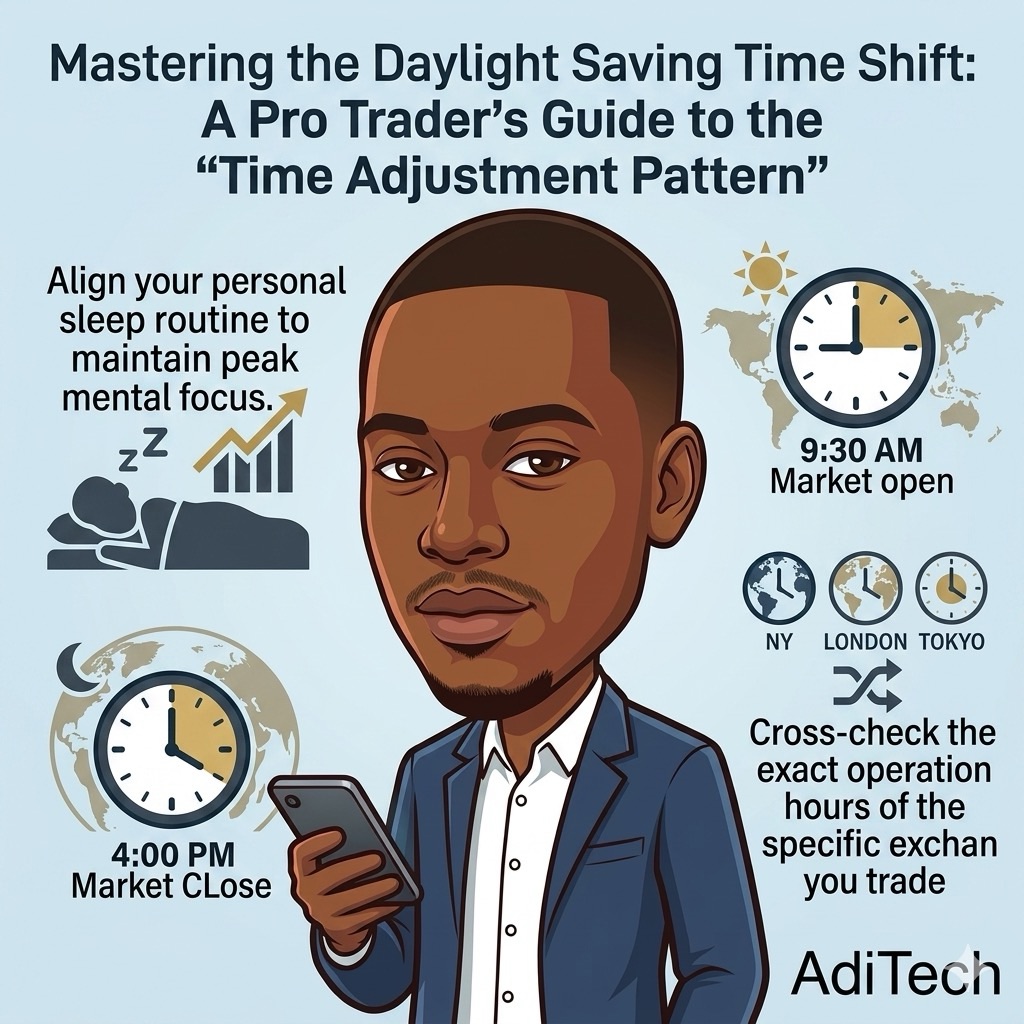
When the United States “falls back” or “springs forward,” it disrupts global market schedules. Understanding how this impacts liquidity, algorithmic execution, and news macro-events can save you from costly mistakes and unlock unique short-term opportunities.
1. The Global Market Disconnect (The Few Days Transition Window)
The core of the Time Adjustment Pattern lies in regional scheduling differences. Not all countries change their clocks on the same day, and many regions do not observe DST at all.
- The Mismatch: When the U.S. shifts its clocks in early November, Europe typically has already shifted, or Asia remains unchanged.
- The Result: The vital London-New York overlap, which usually occurs between 8:00 AM and 12:00 PM EST(Eastern Time) temporarily shifts by an hour.
During this few days transition, market volume peaks at unfamiliar times. Unprepared traders get caught off guard by early volume drops or unexpected volatility spikes.
2. Impact on Trading Algorithms and Automation
Automated trading systems, bots, and technical indicators rely heavily on time-blocked parameters.
- The Risk: If your trading bot is set to trade an “Opening Range Breakout” based on fixed server time rather than local market time, it may execute trades an hour too early or too late. This mismatch is a leading cause of false breakout signals.
- The Pro Edge: Professional traders manually audit and adjust their algorithmic time filters, indicator resets, and bot execution windows ahead of the time shift. This ensures consistent execution while exploiting the messy fills of unadjusted bots.
3. High-Impact News Shifts
Macroeconomic data drops, such as Non-Farm Payrolls (NFP), Consumer Price Index (CPI), and Federal Open Market Committee (FOMC) meetings, always adhere strictly to U.S. local time.
For international traders, a failure to account for the U.S. time shift means miscalculating when news breaks. Pro traders track these economic calendars meticulously during transitional weeks. They position themselves safely before data drops, capitalising on the sudden liquidity vacuums left by confused market participants.
4. The Psychological and Routine Edge
Success in trading requires rapid reaction speeds and high mental clarity. Even a minor one-hour time shift can disrupt sleep cycles, energy levels, and focus.
While retail traders struggle with fatigue during the transitional week, professional traders proactively adjust their sleep schedules and daily routines days in advance. This psychological preparation keeps them sharp, giving them a cognitive edge when market discipline matters most.
Quick Checklist for the Next Time Shift
To turn the Time Adjustment Pattern into your professional advantage, follow this four-step checklist:
- Verify: Cross-check the exact operation hours of the specific exchanges you trade.
- Adjust: Update your automated systems, indicators, and chart session breaks.
- Sync: Confirm the exact release times for major economic news announcements.
- Adapt: Align your personal sleep routine to maintain peak mental focus.
I wasn’t sure what to expect at first, but this turned out to be surprisingly useful. Thanks for taking the time to put this together.
What a helpful and well-structured post. Thanks a lot!
Always My Pleasure
Great job simplifying something so complex.
You have a real gift for explaining things.